Twice a week, someone asks me the same question at the counter: “Is the cruise in my car the fancy kind or the plain kind?” It’s a fair question, because from the driver’s seat the buttons can look almost identical. The difference only shows itself once a slower car pulls in front of you.
One version holds a speed and ignores everything ahead. The other watches the traffic and adjusts. Knowing which one you’ve got is the single most useful thing you can learn about your car’s driving aids, so let’s sort it out properly.
Key takeaways
- Regular cruise control holds one set speed and will not slow down for slower traffic ahead.
- Adaptive cruise control uses radar or a camera to keep a set gap from the car in front, adjusting speed on its own.
- You can tell them apart by the dashboard icon: a car symbol with distance bars means adaptive.
- Neither one steers, and neither replaces an alert driver with hands on the wheel.
The core difference in one breath
Regular cruise control, sometimes called standard or conventional cruise, does exactly one job. You set a speed, say 65 mph, and the car maintains it until you brake, tap the pedal, or cancel. If a slower car cuts in, regular cruise happily marches right up behind it and waits for you to react.
Adaptive cruise control, or ACC, adds a forward sensor to the mix. It still holds your set speed on open road, but when it detects a slower vehicle ahead it eases off the throttle, sometimes brakes, and paces that car at a following distance you choose.
Good to know
Brands use different names for the same idea: Toyota calls it Dynamic Radar Cruise Control (DRCC), Honda uses ACC, Hyundai and Kia call it Smart Cruise Control (SCC), and Nissan bundles it into ProPILOT Assist. They all do the same core job.
For the full walkthrough of how the adaptive version works, our complete adaptive cruise control guide is the deep reference. This article is the quick comparison to get you oriented.
Side by side
| Feature | Regular cruise | Adaptive cruise |
|---|---|---|
| Holds a set speed | Yes | Yes |
| Slows for traffic ahead | No | Yes |
| Keeps a following gap | No | Yes, adjustable |
| Works in stop-and-go | No | On some systems |
| Needs a clean sensor | No | Yes, radar or camera |
How to tell which one you have
You don’t need the owner’s manual, though it helps. The fastest tell is the dashboard. When you switch cruise on, watch the instrument cluster.
- Regular cruise shows a simple speedometer needle icon or the word “CRUISE” with your set speed.
- Adaptive cruise shows a small car symbol, usually with one to four bars or a distance graphic in front of it.
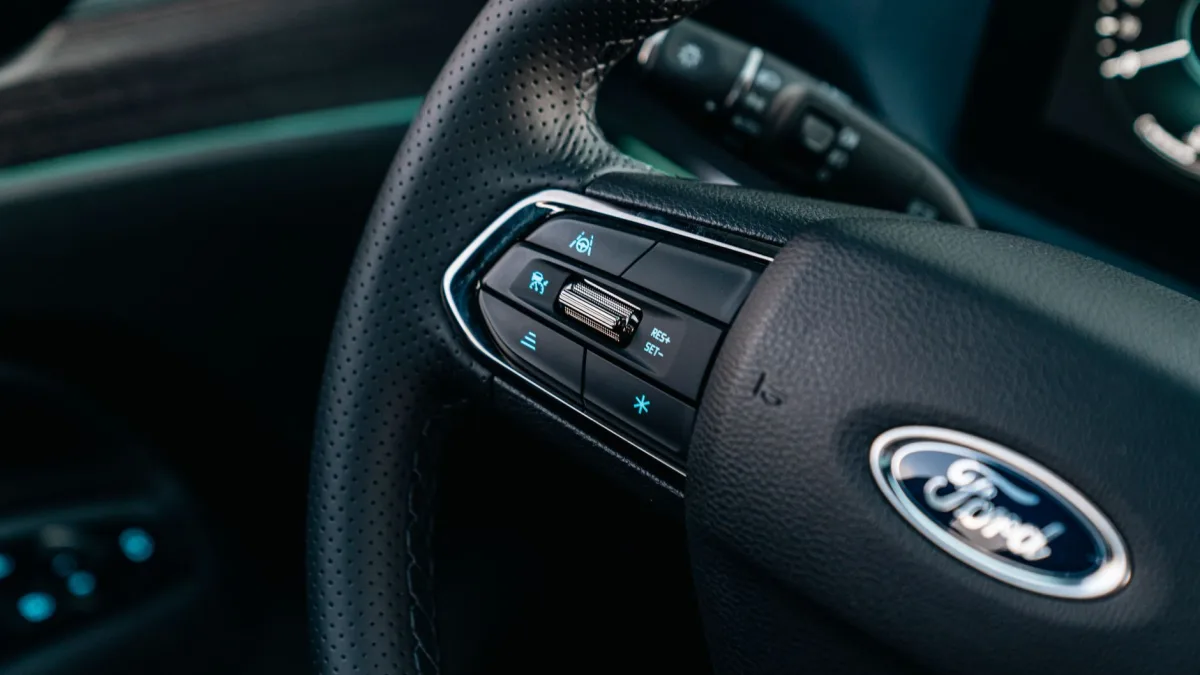
- A button on the wheel with a car-and-distance icon almost always means you have the adaptive kind.
- If you can press a button to change the following gap, it’s adaptive, period.
Tip
Test it safely on an empty stretch of highway. Set your speed with clear road ahead, then let a slower vehicle drift into your lane at a distance. If your car eases off on its own, you have adaptive cruise. If it keeps charging, you have regular cruise.
When each one shines
Regular cruise control
Don’t count the plain version out. On a wide-open interstate at 2 a.m. with almost no traffic, regular cruise is smooth, predictable, and never second-guesses itself. There’s no sensor to get dirty and no weather condition that switches it off.
It also tends to be the one on older cars, roughly pre-2015 on mainstream models, and on base trims even today. Simple, reliable, and cheap to fix.
Adaptive cruise control
Adaptive shines exactly where regular cruise gets annoying: moderate to heavy traffic, long commutes, and rolling highway packs where speeds keep shifting. Instead of tapping the pedal every 30 seconds, you let the system pace the flow.
The trade-off is that adaptive cruise depends on a clear-eyed sensor. When the radar or camera can’t see, the feature backs off. If yours keeps quitting on you, our guide to adaptive cruise dropping out while driving covers the usual culprits, and the radar obstructed message fix handles the most common warning.
Regular cruise is a thermostat for your right foot. Adaptive cruise is a thermostat that also watches the road ahead.
The following distance factor
This is the feature that surprises new adaptive-cruise drivers the most. You get to choose how much space the car leaves ahead, usually three or four settings from close to far.
Pick a longer gap for slick roads or nervous passengers, a shorter one for steady traffic. The car does the math and holds it. Our breakdown of following distance settings explains what each bar actually translates to in car lengths and seconds.
Watch out
Adaptive cruise is not automatic emergency braking, and it is not self-driving. It can be slow to react to a fully stopped object or a car that stops suddenly. Keep your foot ready and your eyes up, no matter how relaxed the system feels.
Cost and repair differences
From a wallet standpoint, the two systems live in different worlds. Regular cruise is a handful of switches and some software, so a repair is often minor. Adaptive cruise brings radar and camera hardware that can be genuinely expensive to replace or recalibrate.
A forward radar module can run anywhere from $400 to well over $1,200 depending on the brand, and calibration after certain repairs adds shop time on top. That’s why body and glass work matters so much on ACC cars.
If you’re weighing a repair, the U.S. safety regulator’s overview at NHTSA is a good neutral source on why these systems are worth keeping in working order rather than ignoring the warning light.
Brand quirks worth knowing
Because adaptive systems differ under the badge, the same symptom can mean different things on different cars. A Toyota that keeps losing radar cruise and a Subaru EyeSight that won’t hold a gap usually need different diagnostics.
If you’ve narrowed it down to your make, we have focused help for Toyota DRCC problems, Subaru EyeSight adaptive cruise, Honda low-speed follow, and Hyundai and Kia Smart Cruise.
Which one is right for you
If you mostly drive light-traffic highways and value simplicity, regular cruise does the job without fuss. If you fight daily congestion or log long interstate miles, adaptive cruise genuinely takes a load off your leg and your nerves.
Most of all, know which one you have before you rely on it. A driver who assumes their plain cruise will slow for traffic is setting up for a hard stop that never comes, and that misunderstanding is the one that ends up in my bay.
Questions drivers ask
Watch the dashboard when you turn cruise on. Adaptive systems show a small car icon with distance bars in front of it, and they have a button to change the following gap. Regular cruise just shows a set speed with no distance graphic.
No. Standard cruise holds one set speed and does nothing about slower traffic ahead. You have to brake or cancel it yourself. Only adaptive cruise slows automatically to keep a gap.
For heavy commuters and long-distance highway drivers, yes. It reduces fatigue by pacing traffic for you. If you mostly drive empty roads, plain cruise may be all you need and it is cheaper to maintain.
Some systems do and some do not. Stop-and-go capable versions can bring you to a full stop and creep again, while older or basic systems shut off below about 25 mph. Check your owner manual for your specific trim.
No. It only manages speed and following distance in your lane. It does not steer, and it can be slow to react to a fully stopped object. You must stay alert with your hands on the wheel.