A friend called me last spring after buying a clean-looking 2019 crossover from a small lot. Great price, tidy interior, no warning lights on the drive home. Two weeks later the lane-centering quit on the highway and a yellow message flashed that he had never seen during the test drive. When I pulled it into the bay, the front camera bracket had been zip-tied back on after a fender bump, and the previous owner had simply switched the system off in the menu so nothing would light up for a sale.
That is the exact trap this checklist is built to catch. Modern driver-assist gear is expensive to fix and easy to hide, so a used car with quiet ADAS (advanced driver assistance systems) is not the same as a used car with working ADAS.
Key takeaways
- A dark dashboard does not prove the safety systems work. Many can be switched off in a settings menu.
- Front camera, radar, and corner sensor locations are the first places body damage and sloppy repairs show up.
- Always test each feature on a real drive, and always scan for stored fault codes before you sign.
- Budget a possible recalibration into your offer if the car has fresh glass, paint, or suspension work.
Before you leave the driveway: the walk-around
Start cold, before the seller warms the car up for you. A five-minute walk-around tells you more than most people expect, because ADAS sensors live in predictable spots and they hate being tampered with.
Look at the top center of the windshield behind the mirror. That black housing is the forward camera for systems like Subaru EyeSight, Toyota’s Pre-Collision setup, and Honda CMBS. Then look low, at the grille and lower bumper, for the radar module and the corner parking sensors.
- Windshield glass: is it aftermarket, and does the camera area look factory or hand-fitted?
- Front bumper and grille: mismatched paint, gaps, or a radar emblem that sits crooked.
- Corner sensors: all present, same color, none painted over or cracked.
- Side mirrors: intact blind-spot indicators and clean housings, common for Ford BLIS.
- Rear bumper: reverse sensors and any rear radar for cross-traffic alert.
Watch out
Fresh windshield glass is the single biggest red flag. A replaced windshield almost always requires a camera recalibration, which runs roughly $150 to $400. If the seller cannot show you paperwork that it was recalibrated, assume it was not.
Sit inside and check the menus
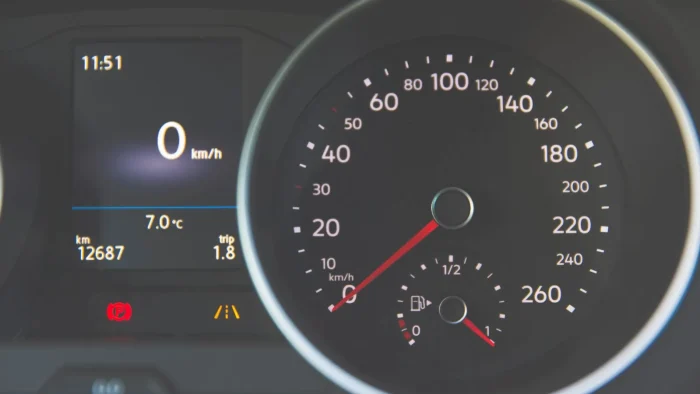
Now get in and turn the key to accessory, then start it. Watch the cluster during the bulb check. Every warning icon should flash on and then clear once the system boots. A car that never shows a lane-departure or pre-collision icon at all may have had that module disabled or unplugged.
Dig into the driver-assist settings screen. This is where sellers hide problems. If lane-keep assist, forward-collision braking, and blind-spot monitoring are all toggled off, ask why. Switch every one of them back on and confirm the car accepts the change without throwing an error.
Good to know
Turning a feature off in the menu is not the same as it being broken, but a seller who left everything off before showing the car is either careless or hiding a fault. If you are unsure how these menu toggles differ from a real defect, our guide on whether you can turn off an ADAS system walks through what each setting actually does.
Confirm the icons match the equipment
Cross-check the window sticker or the VIN build sheet against what you see. If the listing brags about adaptive cruise but the steering wheel has no radar cruise buttons, the trim may not have it, or somebody swapped parts. Amber symbols you do not recognize are worth decoding before you assume the worst, and our breakdown of amber dashboard symbols covers the ones buyers ask about most.
The test drive: make every system prove itself
This is where I catch the cars that pass a static inspection but fail in the real world. Plan a route with a stretch of clear highway, a couple of painted-line curves, and an empty lot for the low-speed stuff.
- Adaptive cruise: set it behind traffic and confirm it slows and resumes smoothly.
- Lane keeping: let the wheel drift slightly toward a painted line and feel for the gentle correction.
- Forward-collision warning: it should stay silent in normal driving, no random beeps.
- Blind-spot monitor: have a car pass you and watch for the mirror light.
- Rear cross-traffic: back out of a spot slowly and confirm the alert triggers.
- Auto high beams and parking sensors: simple, but they reveal wiring gremlins.
A car that behaves perfectly on a static lot and then nags, flickers, or goes dark at 60 mph is telling you something the seller would rather you missed.
If any warning appears during the drive, do not let the seller wave it off as a fluke. A steady ADAS warning light means a module is unhappy, and our guide on what to do when an ADAS warning comes on explains which ones are safe to drive with and which are not.
Scan for hidden codes before you sign
Here is the step most buyers skip and later regret. A car can drive fine, clear its dashboard, and still carry stored trouble codes from a module that failed intermittently. A basic scan pulls those out.
A cheap generic reader will only see engine codes. To read the camera, radar, and blind-spot modules you need a tool that talks to those systems. If you do not own one, a mobile mechanic will scan a car for around $40 to $100, which is cheap insurance on a purchase this size.
Tip
Bring your own scanner or your own mechanic. A seller who resists a pre-purchase scan is a seller worth walking away from. If you want to buy your own reader, our rundown of scan tools for ADAS beginners covers what actually reads these modules.
Watch specifically for codes tied to calibration or alignment. Words like camera not calibrated, radar blocked, or sensor misaligned tell you the car needs shop time. To understand why that matters and how it works, the basics of ADAS recalibration are worth a read before you negotiate.
Factor repair costs into your offer
If the car has fresh paint on a bumper, a new windshield, or recent suspension work, assume a recalibration is owed. That is not a dealbreaker, it is a bargaining chip. Bake the number into your price.
| Situation on the car | Likely follow-up | Typical cost |
|---|---|---|
| New windshield, no paperwork | Front camera recalibration | $150 to $400 |
| Repaired front bumper | Radar realignment | $200 to $500 |
| Replaced side mirror | Blind-spot module check | $100 to $350 |
For the full picture on what these repairs run, the ADAS repair cost overview lays out the ranges by system. Independent crash-test data from the IIHS advanced driver assistance research is also worth skimming so you know which features genuinely earn their keep.
Putting the checklist to work
None of this requires special training. It requires patience and a willingness to slow the sale down. Walk the car, work the menus, drive every feature, scan the modules, and price in anything that looks freshly repaired.
If you are still fuzzy on what all these acronyms even mean, start with our plain-English explainer on ADAS warning lights for beginners. A buyer who understands the lights is a buyer who does not get stuck with someone else’s hidden repair bill.
Questions drivers ask
Yes, and it is common. Many features can be switched off in the settings menu so no warning light appears during a test drive. Always turn every driver-assist feature back on and scan the car's modules for stored fault codes before you buy.
Only if it has had certain repairs. A replaced windshield, repaired front bumper, or new suspension parts usually require recalibration. If the car is untouched and every feature works on the drive, you likely do not need one.
A basic engine code reader will not see the camera or radar modules. You need a scan tool that reads driver-assist systems, or you can pay a mobile mechanic roughly $40 to $100 to scan it for you.
Not automatically, but it is a red flag. A new windshield almost always requires a front camera recalibration costing $150 to $400. Ask for recalibration paperwork, and if there is none, use it to negotiate the price down.
Plan a route with clear highway, painted-line curves, and an empty lot. Set adaptive cruise behind traffic, let the car drift toward a lane line to feel the correction, and have a car pass you to check the blind-spot monitor.