This question lands on my service counter more than almost any other now: “I’m getting an alignment, do I need to pay for that ADAS calibration too, or is the shop just padding the bill?” Fair suspicion. Some shops do throw it on automatically, and some absolutely should.
The honest answer is that it depends on what the alignment actually changed. A quick toe tweak is one thing. Resetting thrust angle after a suspension repair is another animal entirely.
So let me answer the real questions drivers ask me, in plain terms, so you know when alignment ADAS calibration is a legitimate requirement and when you can politely decline.
Key takeaways
- Wheel alignment can change the direction your car actually travels, which shifts the aim of radar and cameras that reference the vehicle’s centerline.
- A minor toe adjustment usually does not require calibration; a thrust-angle correction or suspension repair often does.
- Camera calibration references straight-ahead travel, so a car that tracks crooked before alignment can confuse the system afterward.
- When in doubt, ask the shop what changed and whether the manufacturer requires calibration for that specific work.
Q: What does wheel alignment have to do with cameras and radar?
More than most people expect. Your forward radar and forward camera are aimed relative to the direction the car travels straight ahead, called the thrust line. That is the path the rear axle actually pushes the car down.
If the alignment is off, the car’s real straight-ahead differs from where the sensors think straight-ahead is. The radar might be pointed a degree to one side of the true travel path, so it reads the lane next to you instead of your own.
Alignment resets that thrust line. When it moves, the reference the sensors were calibrated against moves with it.
Good to know
Thrust angle is the difference between the car’s geometric centerline and the direction the rear axle actually steers the car. A car with a bad thrust angle “dog-tracks,” running slightly sideways down the road. The forward camera calibrated on that crooked path will be aimed wrong once you straighten it out.
Q: Does every alignment require a calibration?
No, and this is where the padding suspicion is sometimes earned. Not all alignment work disturbs the sensors’ reference enough to matter.
Here is roughly how it breaks down by job.
| Alignment job | Calibration usually needed? |
|---|---|
| Minor front toe adjustment | Often no |
| Four-wheel alignment, larger corrections | Sometimes, model dependent |
| Thrust-angle correction | Frequently yes |
| Alignment after suspension or steering repair | Usually yes |
The deciding factor is how much the true travel path changed and what the manufacturer specifies. Some brands, Honda and several German makes among them, call for a camera calibration any time the alignment changes measurably. Others only require it when the rear thrust angle is corrected.
Watch out
The most common way this bites people: a car comes in pulling to one side, gets a big alignment correction, and drives away with the forward camera still aimed at the old crooked path. Lane keep starts nudging toward the wrong side of the lane, and the owner blames the alignment shop for “breaking” the assist. The alignment was fine. The camera just needed to relearn straight-ahead.
Q: How do I know if my specific job needs it?
Ask the shop two direct questions before they start, and one after.
- Before: “Is this a simple toe adjustment or a full correction including thrust angle?”
- Before: “Does the manufacturer require an ADAS calibration for the alignment work on my model?”
- After: “How much did the thrust angle and total toe actually change from spec?”
- If a warning light appears after alignment: treat it as a calibration flag, not a coincidence
A good alignment shop already knows which vehicles trigger a mandatory calibration and will tell you upfront. If they cannot answer, that is your cue to check the requirement yourself. Our rundown of when ADAS calibration is required lists alignment among the events that can trigger it, alongside glass and body work.
Q: Can the alignment shop do the calibration too?
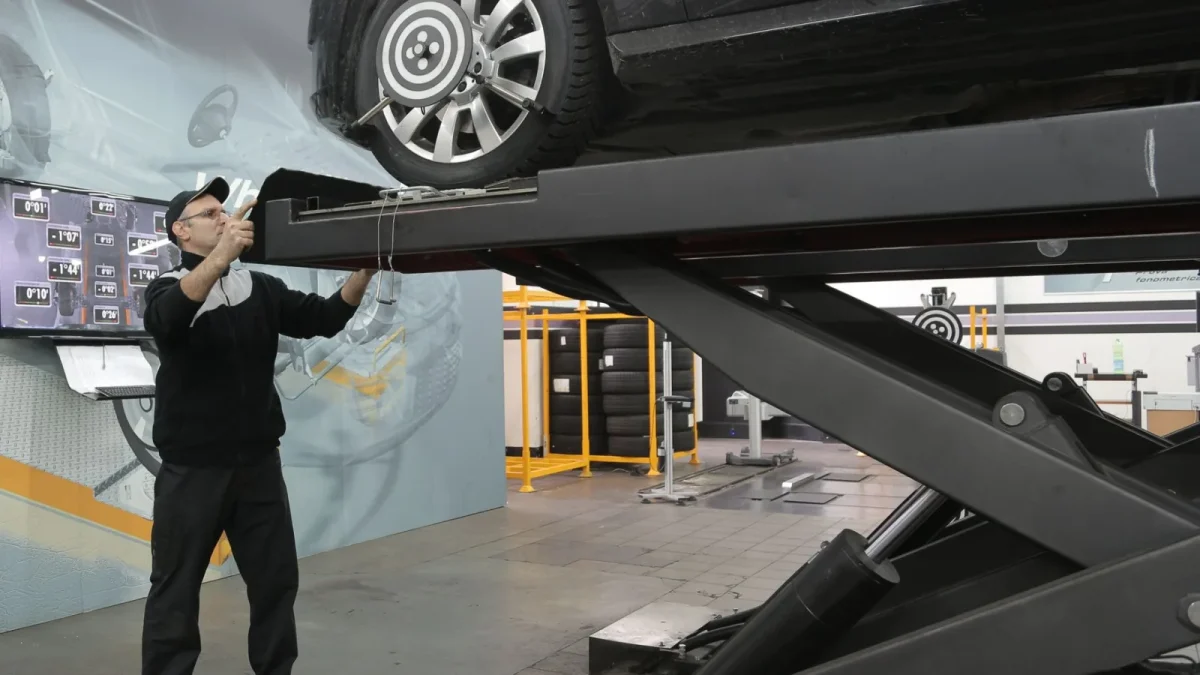
Some can, many cannot. A well-equipped independent or a dealer may have the calibration targets and factory scan tool on site. A basic tire-and-alignment shop often does not.
If they cannot calibrate, the honest ones will tell you to take it to a dealer or ADAS specialist afterward. The dishonest move is charging you for a calibration line item and never actually performing the procedure, so ask for a printed calibration report if they claim to have done it.
A calibration you paid for but that was never actually run is worse than skipping it, because now you trust a system that no one verified.
Q: Is alignment calibration the same as after a windshield?
Not quite, and the difference is worth understanding. A windshield swap physically moves the camera, so the camera itself needs re-aiming.
An alignment does not touch the camera at all. It changes the direction the car travels, which changes what “straight ahead” means to the camera. The camera did not move, but its frame of reference did.
The calibration procedure often looks similar, static targets or a validation drive, but the trigger is different. If you want the full comparison of the two procedures and when each applies, static vs dynamic ADAS calibration explained breaks down the methods in detail.
Tip
If you are getting an alignment because the car was pulling, and you also recently had a windshield or bumper repair, bundle the calibration. Doing the alignment and the calibration in one visit is cheaper than two separate trips, and it guarantees the camera learns the corrected travel path instead of the old one.
Q: What does the calibration add to my bill?
When it is genuinely required, expect the calibration to run $150 to $400 on top of the alignment, depending on whether your car needs static targets, a dynamic drive, or both. That is a real number, not a scam, but only when the work actually warrants it.
The frustration is that some drivers pay it when a simple toe adjustment did not require it, and others skip it when a thrust-angle correction genuinely did. Knowing which camp your job falls into is the whole game. For the broader cost picture across all calibration triggers, our guide to ADAS calibration cost gives you the ranges to expect.
Q: What should I do right now?
If you have an alignment booked, ask the two before-questions above and let the answers guide you. If you already had one and a driver-assist warning light appeared afterward, do not ignore it, that is often the car asking for a calibration.
And if no light appeared but the assist features feel slightly off, nudging you oddly in the lane or beeping at the wrong moments, get the camera checked. A subtle misalignment does not always throw a code.
For the complete map of how every sensor, calibration, and service event ties together, the hub guide to ADAS cameras and sensors is your reference point. For a neutral outside explainer on how these driver-assist systems are meant to work, MyCarDoesWhat walks through each feature in plain language.
The short version: alignment can absolutely require calibration, but not always. Ask what changed, and the answer usually makes itself obvious.
Questions drivers ask
No. A minor front toe adjustment often does not, while a thrust-angle correction or an alignment after suspension repair frequently does. The deciding factor is how much the car's true travel path changed and what your manufacturer specifies for that work.
The camera is calibrated relative to the direction the car travels straight ahead, called the thrust line. An alignment resets that line, so a camera set on the old crooked path can end up aimed wrong and nudge you toward the wrong part of the lane.
When it is genuinely required, calibration usually adds $150 to $400 on top of the alignment, depending on whether your car needs static targets, a dynamic drive, or both. It is a real charge, but only when the alignment work actually warrants it.
Some can, many cannot. A well-equipped independent or dealer may have the targets and factory scan tool on site, while a basic tire shop usually does not. If they cannot calibrate, they should refer you to a dealer or ADAS specialist rather than skip it.
The camera was likely still aimed at the old travel path after the alignment corrected the car's direction. That mismatch makes lane keep nudge toward the wrong side of the lane. A calibration re-teaches the camera the corrected straight-ahead and fixes it.