My neighbor bought a three-year-old crossover last spring and drove it for a week before she asked me a question at the mailbox. Her old car never beeped when she drifted toward a lane line. This one did, and it sometimes tugged the wheel back on its own. Was something wrong with it?
Nothing was wrong. Her new car simply had ADAS, and her old one did not. That single acronym explained every new noise, nudge, and light she had been living with all week.
If you are in the same spot, staring at features you did not ask for and cannot name, this is the article that clears it up. No jargon dumped on you, no fault codes, just what the letters stand for and what each piece actually does.
Key takeaways
- ADAS stands for Advanced Driver Assistance Systems: the cameras, radar, and sensors that help you drive but never replace you.
- The common systems are collision braking, lane keeping, blind spot monitoring, adaptive cruise, and parking sensors.
- Every brand uses its own names for the same jobs, which is most of the confusion.
- None of these features make a car self-driving. You steer, you watch, you stay in charge.
Breaking down the acronym
ADAS is short for Advanced Driver Assistance Systems. Read it slowly and the meaning is right there in the words. These are systems that assist the driver. Advanced only means they use cameras and radar rather than the simple mechanical helpers of older cars.
The key word is assistance. Every one of these features is designed to support the person behind the wheel, not take over for them. When people forget that word, they get in trouble, either by over-trusting the car or by fearing it.
For the wider picture of how these systems fit together with the warning lights they throw, our overview of ADAS warning lights explained for beginners is the pillar that ties everything together. Think of this article as the vocabulary lesson that comes first.
The sensors doing the work
Before we name the features, it helps to know what they are looking through. Three kinds of sensors do almost all of it.
The forward camera lives behind your rearview mirror, staring out through the windshield. It reads lane lines, road signs, and the shapes of cars and people. This is why a cracked windshield or a windshield replacement can knock out several features at once.
The radar unit hides behind the grille or in the lower bumper. It measures distance and closing speed to whatever is ahead. Radar sees through darkness and light rain far better than a camera.
Ultrasonic sensors are the little round pucks in your bumpers. They handle close-range work: parking beeps and low-speed obstacle warnings.
Good to know
Most ADAS features rely on more than one sensor at a time. That is why a single blocked camera can disable lane keeping, collision braking, and traffic-sign reading all together, even though nothing is broken.
The features you actually have
Here is the plain-language tour of the systems most cars from about 2018 onward carry. Once you can name them, the dashboard stops feeling random.
Automatic emergency braking
Also called forward collision or pre-collision, this watches the car ahead and slams the brakes if you do not react in time. Honda calls its version CMBS, Toyota folds it into the Pre-Collision System. It is the single feature that has saved the most fender-benders in my experience.
Lane keeping and lane centering
Lane departure warning beeps when you drift. Lane keep assist gently steers you back. Lane centering, like Toyota’s LTA or the steering half of Subaru EyeSight, actively holds you in the middle. All three read the painted lines through the forward camera.
Blind spot monitoring
That little light in your side mirror that glows when a car is beside you is blind spot monitoring. Ford brands it BLIS. It uses short-range radar in the rear corners of the car, and it is one of the features drivers miss most when they switch to a car without it.
Adaptive cruise control
Regular cruise holds one speed. Adaptive cruise adjusts your speed to match the car ahead using that front radar. It will slow you in traffic and speed back up when the lane clears, and you still do all the steering.
Parking and rear cross-traffic
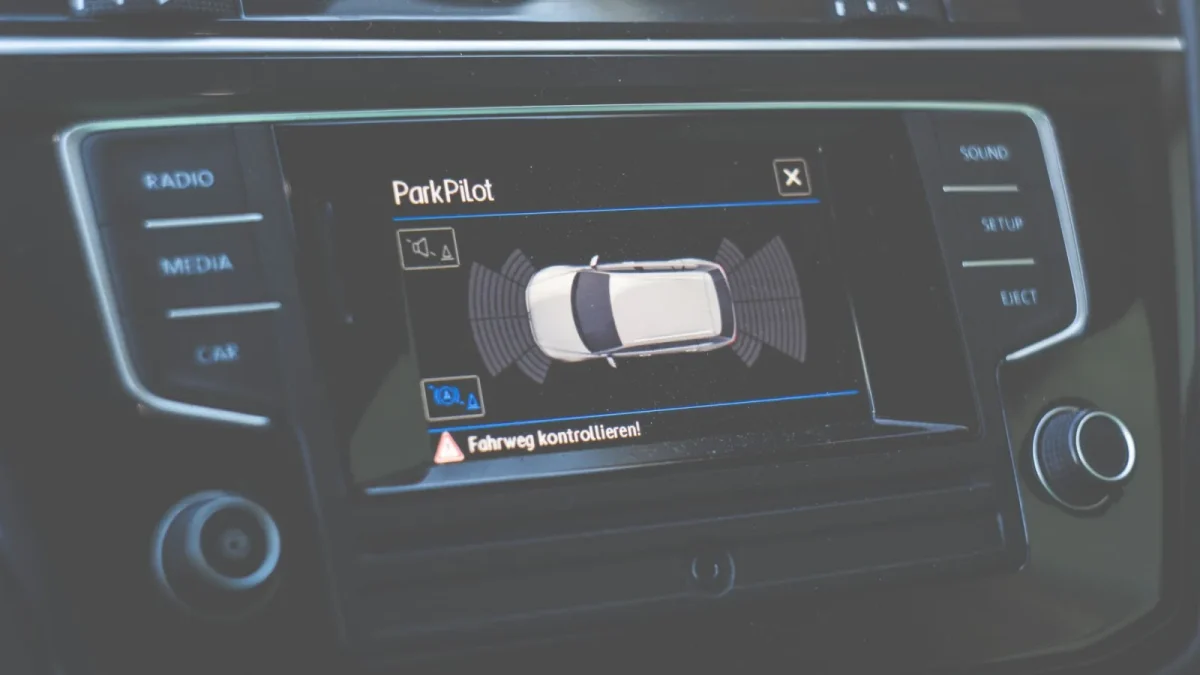
The beeping when you back up, plus the alert when a car is coming down the parking-lot aisle behind you, comes from the ultrasonic pucks and rear radar working together.
Tip
Spend ten minutes with your owner’s manual finding your car’s exact names for these features. Knowing that your “TSS” or “Honda Sensing” bundle includes automatic braking makes every dashboard message far less scary.
Why every brand sounds different
This is the part that makes ADAS feel more complicated than it is. The jobs are identical across the industry, but every automaker slaps its own marketing name on the bundle.
| Brand | Bundle name | Covers |
|---|---|---|
| Toyota | Toyota Safety Sense | Braking, LTA lane centering, radar cruise |
| Honda | Honda Sensing | CMBS braking, lane keep, adaptive cruise |
| Subaru | EyeSight | Camera-based braking, lane centering, cruise |
| Ford | Co-Pilot360 | BLIS blind spot, braking, lane keep |
Underneath those four names sit the same handful of features. Once you learn that “Honda Sensing” just means Honda’s ADAS bundle, the mystery mostly evaporates.
The technology is boringly similar from brand to brand. It is the marketing names that make owners think their car is unique. It usually is not.
What ADAS is not
I have to be firm about this because the confusion is dangerous. ADAS is not self-driving. Not one feature on your car, no matter how fancy the name, removes your legal or physical responsibility to drive.
Lane centering will drift wide on a faded line. Adaptive cruise can be late to spot a stopped car. Automatic braking reduces a crash, it does not guarantee avoiding one. These are helpers with real limits, and treating them as a chauffeur is how people crash.
There is a whole family of myths built on this misunderstanding, and some of them cost real money. Our roundup of common ADAS myths that waste money is worth reading right after this one.
When the systems act up
Because ADAS leans entirely on sensors, its most common complaint is a warning light, not a mechanical failure. A dirty camera, a snow-packed grille, or a low winter sun can knock a feature offline for perfectly normal reasons.
When that happens, the fix is often as simple as cleaning a lens and restarting the car. If you would rather have a calm plan for the moment a light appears, our step-by-step guide on what to do when an ADAS warning comes on walks it from the first chime forward.
Watch out
Do not assume an amber ADAS light means an expensive sensor died. Far more often it means a sensor is simply blocked or the system reset itself after a battery event. Rule out the cheap causes before you approve any parts.
Getting comfortable with your co-pilot
ADAS is one of the genuinely good things about modern cars. Blind spot monitoring and automatic braking prevent real crashes, and adaptive cruise takes the fatigue out of a long highway pull. The features are worth learning to trust at the right level.
Learn the names your car uses, know which sensor drives which feature, and remember that a warning is usually the car being honest rather than broken. For plain descriptions of what each feature does in real driving, MyCarDoesWhat is a genuinely friendly resource, and the NHTSA site has straight-shooting safety information on the same systems.
Once the acronym stops being a mystery, the car stops feeling like it is doing things behind your back. It is just assisting, exactly as the name promises.
Questions drivers ask
ADAS stands for Advanced Driver Assistance Systems. It is the umbrella term for camera, radar, and sensor-based features like automatic braking, lane keeping, and blind spot monitoring that support the driver without replacing them.
Most cars built from about 2018 onward carry at least some ADAS features, and automatic emergency braking is now standard on many models. Older cars may have none, which is why the features feel new to buyers moving up.
No. ADAS features assist the driver but never remove your responsibility to steer, watch the road, and stay in control. Lane centering and adaptive cruise have real limits and can be fooled by faded lines or stopped traffic.
Those are just brand names for the same ADAS features. Toyota Safety Sense, Honda Sensing, Subaru EyeSight, and Ford Co-Pilot360 all bundle collision braking, lane keeping, and cruise under different labels.
Mainly three: a forward camera behind the windshield for lane lines and signs, radar behind the grille for distance and speed, and ultrasonic sensors in the bumpers for close-range parking work.