You are rolling up on a slower car, maybe glancing at the radio, and suddenly the dash flashes a red icon and a sharp chime fills the cabin. Your heart jumps. That symbol is forward collision warning, and it just did exactly what it was built to do: grab your attention before you rear-ended someone.
The trouble is that the same family of icons can show up in different colors and mean very different things. A steady amber symbol at startup is not the same as a flashing red one at 55 mph.
Let me walk you through what that light means, why the color matters, and whether the car or you is still doing the braking when it appears.
Key takeaways
- Forward collision warning is an alert, not a brake. It tells you a crash looks likely so you can react first.
- Flashing red with a chime means brake now. Steady amber usually means the feature is unavailable or has a fault.
- The warning is the first stage of a two-part system. Automatic emergency braking is the second stage that steps in if you do nothing.
- A warning light stuck on at startup often points to a blocked or dirty sensor rather than a broken system.
What the forward collision warning symbol looks like
Most versions show a car with lines or an exclamation mark in front of it, and some add radar-style waves. The exact drawing changes brand to brand, but the message is always the same: the vehicle ahead is getting close fast.
On many cars the warning also projects onto the head-up display or flashes in the gauge cluster, so you catch it even without looking down.
Because so many ADAS icons share the same car-with-a-shape look, drivers mix them up constantly. If you cannot place yours, our AEB warning lights and symbols chart lines up the common ones so you can match your dash quickly.
Color is your fastest clue
Before you read a single word of the manual, the color tells you the mood of the system.
Flashing red
This is the real thing. A flashing red symbol paired with a loud chime means the car sees an imminent collision and wants you to brake immediately. It is the alert working as intended, and it should make you hit the pedal without thinking.
Steady amber or yellow
A symbol that glows amber and stays on, usually at startup or mid-drive, is a different animal. Here the car is telling you the feature is unavailable or faulted. Something is blocking it, or a sensor needs attention.
Good to know
A quick amber flash at engine start that clears within a few seconds is normal. That is just the system running its self-check. Only worry if the light stays lit after the car is fully running.
Does the car brake, or do you?
This is the question I get most, and the answer surprises people. On its own, forward collision warning does not brake at all. It only warns.
The braking comes from a separate but linked feature, automatic emergency braking, which activates if you fail to respond to the warning. Think of the warning as the shout and the braking as the hands that grab the wheel.
The warning is your chance to fix it yourself. The braking is what happens when you miss that chance.
Because these two get tangled together, it is worth understanding where one ends and the other begins. Our breakdown of AEB versus forward collision warning spells out the handoff in plain terms.
Watch out
Never treat the warning as a license to follow too closely. The alert is calibrated to fire late, right before a crash. If you rely on it to manage your following distance, you are already too close.
Why the light might be stuck on
If the amber symbol will not clear, the system is blocked or faulted. In my experience the causes fall into a short list, easiest first.
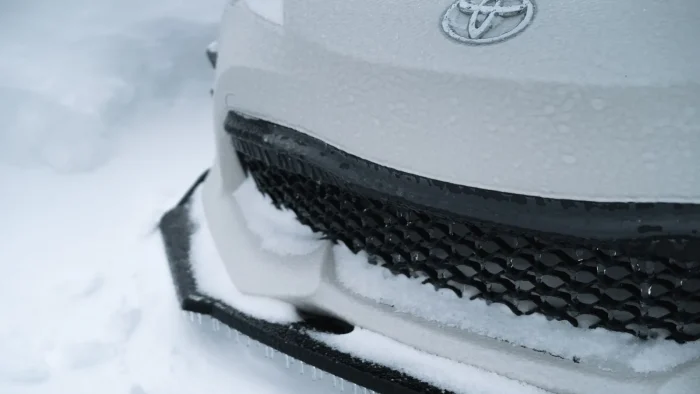
- A dirty or iced-over camera behind the windshield, or a grille sensor packed with snow or mud.
- A bug-smeared windshield right in front of the camera lens.
- Heavy fog, rain, or low sun glare confusing the sensors, which usually clears on its own.
- A calibration fault after a windshield swap or front-end repair.
- An actual sensor or wiring failure that needs a scan tool to diagnose.
Start with the free fixes. Wipe the camera area and clean the grille before you assume the worst. A surprising number of these lights vanish after a two-minute cleaning.
When it fires for no reason
Sometimes the warning goes off, or the car even brakes, with nothing ahead. That is a false alarm, and it is different from a fault light.
Common triggers are overpasses, cresting hills, metal signs on curves, and cars in the next lane on a bend. If yours does this, our guide to why your car brakes for no reason covers the real culprits and what actually stops them.
How your brand handles it
Automakers tune the warning timing and sensitivity differently, and many let you adjust how early it fires through a menu setting.
| Brand | What they call it | Adjustable timing |
|---|---|---|
| Toyota | Pre-Collision System alert | Yes, near/mid/far |
| Honda | Forward Collision Warning | Yes, long/normal/short |
| Subaru | EyeSight pre-collision alert | Limited |
Toyota drivers can fine-tune sensitivity through the Toyota Pre-Collision System warnings menu, which helps if the alert feels too jumpy or too late for your driving style.
What to do when the light appears
Your response depends entirely on the color and behavior.
- Flashing red with a chime: brake now, then check your following distance.
- Steady amber at startup that clears: nothing, it is a normal self-check.
- Steady amber that stays lit: clean the camera and grille, then have it scanned if it persists.
- Warning fires with nothing ahead: note where it happens, since a pattern points to phantom braking.
To see how this alert fits into the bigger picture of collision-avoidance systems, our hub on automatic emergency braking explained connects the warning to the braking and the sensors behind both.
For a neutral, plain-language rundown of what these features do, MyCarDoesWhat is a genuinely useful outside resource.
Treat the red flash as a real emergency and the amber light as a maintenance nudge, and this symbol stops being scary. It becomes what it was meant to be: an extra set of eyes watching the road ahead of you.
Questions drivers ask
Not by itself. The warning is only an alert asking you to brake. Braking comes from a linked feature, automatic emergency braking, which steps in only if you fail to react to the warning.
A steady amber symbol usually means the system is blocked or faulted. The most common causes are a dirty camera, a snow or mud packed grille sensor, or glare. Clean the sensor areas first, and have it scanned if the light stays lit.
Yes. A brief amber flash when you start the car is the system running its self-check. It should clear within a few seconds. Only be concerned if the light remains on after the engine is running.
That is a false alarm, often triggered by an overpass, a hill crest, a metal sign on a curve, or a car in the next lane on a bend. If it happens repeatedly in the same spot, the sensors may need to be checked.
On many vehicles, yes. Brands like Toyota and Honda let you set the alert timing to near, normal, or far through a dashboard menu. This helps if the warning feels too jumpy or too late for your driving style.